

By Khushi Singh
Welcome to The Bridge! India’s regulators affect markets, govern disputes, and test the rule of law through their orders, regulations, and policy implementation actions. Yet the quality of this work rarely gets the scrutiny it deserves. The Bridge is TrustBridge’s window into India’s regulatory state: how it decides, how it regulates, and how it could do both better.
Introduction
The absence of a legal member1 at the Electricity Regulatory Commissions (the “ERCs”) and the Petroleum and Natural Gas Regulatory Board (the “PNGRB”) can bring adjudication in India’s energy sector to a halt. This delays capital recovery and causes interests and carrying costs to accumulate over time. The reason often given for transfer of civil courts’ powers from courts to specialised regulators and tribunals is the promise of swift and efficient adjudication of disputes. When long-standing vacancies undermine this efficiency argument, this subverts the very rationale for transferring adjudicatory powers away from traditional courts.
The recently passed Tribunals Reform Bill 2026 aims to improve efficiency, transparency, and uniformity in appointments to tribunals such as the Appellate Tribunal for Electricity (the “APTEL”) and the Securities Appellate Tribunal. This comes amidst significant vacancies and mounting pendencies at tribunals.2 Reportedly, as of December 2025, 94 out of 518 sanctioned tribunal member posts were lying vacant.3
While the new legislation is a welcome measure, it is important to point out that vacancies are also endemic at regulators from whose decisions appeals are preferred to such tribunals. The Tamil Nadu Electricity Regulatory Commission, for instance, has had zero members since 25 June 2026 until the date of this post. This Commission cannot function: no administrative functions, no tariff-setting, and no adjudication of disputes.
Such vacancies raise particularly troublesome problems at energy sector regulators which also function as first-instance adjudicators of contractual disputes among regulated entities and regulatory violations. To adjudicate these disputes, the Boards of these regulators must mandatorily include a ‘Member (legal)’ or a ‘person of law’. For the PNGRB, this requirement for a ‘Member (legal)’ is mandated by its governing Act.4 For ERCs, the Supreme Court prospectively read the mandatory requirement of a ‘person of law’ in State of Gujarat v. Utility Users’ Welfare Assn.5
As part of our work on examining regulatory architecture and functioning, we have been collecting data on legal member vacancies in India’s energy sector regulators. We present this data here.
Methods
In addition to the PNGRB, we examine legal member vacancies at seven ERCs (out of 28). We select these ERCs based on anecdotal evidence of past or on-going vacancies. The seven ERCs are:
Andhra Pradesh ERC (“APERC”),
Central ERC (CERC),
Delhi ERC (“DERC”),
Maharashtra ERC (“MERC”)
Tamil Nadu ERC (“TNERC”),
Telangana ERC (“TGERC”), and
Uttar Pradesh ERC (“UPERC”).
We select 26 June 2007 in respect of the PNGRB and 12 April 2018 in respect of ERCs as the relevant baseline for data collection. This is because the initial appointments of members to PNRGB were made on 26 June 2007 and the Supreme Court prospectively read the requirement of a ‘person of law’ into the Electricity Act, 2003 through its judgment of 12 April 2018.
To collect data regarding names, tenure, and member-categories (finance, technical, or legal), we primarily relied on the annual reports and websites of the respective regulator. Some ERCs, i.e., APERC, DERC, MERC, and UPERC, do not provide this information in either of those sources, and we filed RTIs applications to obtain this information for those ERCs. However, APERC and DERC did not respond, and MERC’s reply lacked relevant data. In these cases, we used the following proxies for tenure date and/or member-category:
The dates on which the DERC’s chairpersons Justice Jayant Nath and Justice SH Umesh Kumar joined and demitted office are unclear. We use proxy dates for these data points based on information available on their website and news reports.
To ascertain members’ categories, we used the following method:
If a chairperson at an ERC was a retired judge, we assume they are qualified as a ‘person of law’;
Otherwise, we used alternate sources to determine the member’s category.
Our data sources are summarised in Table 1 below:
Notes: ‘Y’ indicates the data was available on the source; ‘N’ indicates it was not; ‘N/A’ indicates the source was not applicable/not invoked for that data point (e.g., we only looked at the annual reports when data was not available on the regulator’s website, and RTI was filed only for APERC, DERC, MERC and UPERC). Entries marked with ‘*’ to indicate that information was only partly available on the said source.
Findings
Durations of legal member vacancies at energy sector regulators range from a few weeks to over six years. Notably, the TGERC did not have a legal member for over six-and-a-half years, and the MERC, for over five years. Table 2 summarises the duration of legal member vacancies at the regulators in our study.
As of 1 August 2026, nearly half of the regulators studied have ongoing vacancies. These are:
APERC,
DERC,
TNERC, and
PNGRB
Figure 1 shows the durations and frequency of legal member vacancies across seven ERCs (APERC, CERC, DERC, MERC, TGERC, TNERC, and UPERC) between 12 April 2018 and 01 August 2026.
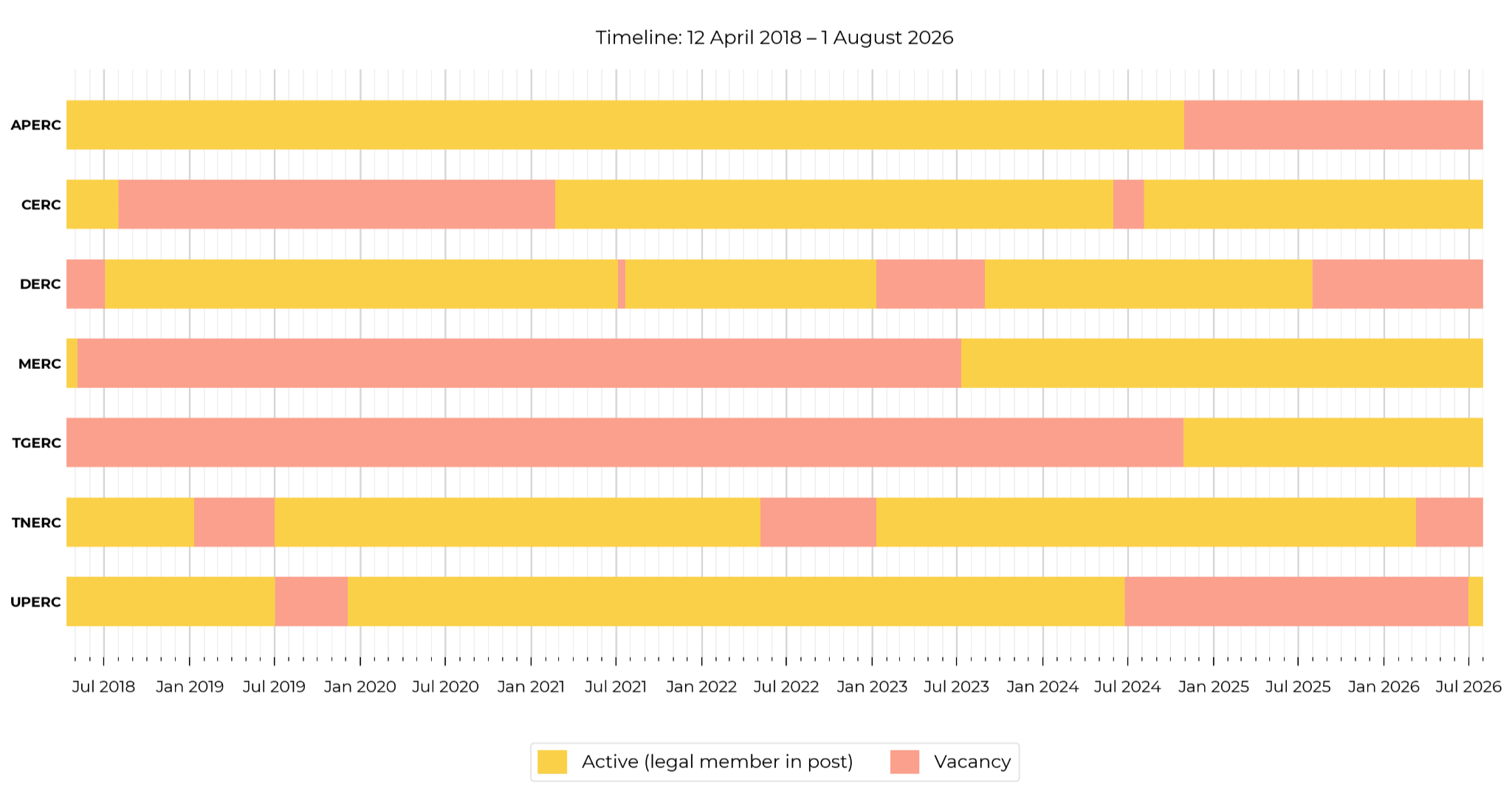
Figure 1: Duration and Frequency of vacancies of legal member at ERCs
MERC and TGERC have had a single long period of vacancy. MERC’s first and only legal member so far, Surendra J. Biyani, was appointed on 11 July 2023. TGERC got its first ‘person of law’ only on 30 October 2024 when retired High Court judge Dr. Justice Devaraju Nagarjun assumed the role of the chairperson.
Figure 1 shows the durations and frequency of legal member vacancies at PNGRB between 26 June 2007 and 01 August 2026.

Figure 2: Duration and Frequency of vacancies of legal member at PNGRB
PNGRB has had a few spells of vacancy since June 2007, with the longest vacancy lasting 1 year, 11 months, 22 days. PNGRB currently has an on-going vacancy, following the departure of its most recent legal member on 15 December 2025.
Conclusion
The data demonstrates that despite legal mandates, India’s energy sector regulators have had multi-year vacancies in the office of the legal members, stretching beyond five and six years in major states like Maharashtra and Telangana. Since legal member vacancies halt the adjudicatory process, the ongoing vacancies in nearly half the regulators studied have resulted in commercial disputes remaining unadjudicated. This points to the need for probing why appointments to regulators face such persistent delays, as well as considering structural reforms to streamline the selection mechanism not just at the tribunals but also at the level of regulators.
- The author is a researcher at TrustBridge, and would like to thank Pratik Datta, Bhavin Patel and Natasha Aggarwal for their feedback.
CITATION
Khushi Singh, 2026. “Missing legal member: Extent of legal member vacancies at India’s energy sector regulators”, The Bridge, TrustBridge Rule of Law Foundation
Thanks for reading The Bridge! Subscribe for free to receive new posts and support our work.
References
Bhavini Mishra, “Tribunal Bill gets Parliament nod, but vacancies, infra remains key hurdles” (Business Standard, 11 August 2026).
Petroleum and Natural Gas Regulatory Board Act, 2006 (“PNGRB Act”), ss. 4(1) and 24.
Rajya Sabha, Unstarred Question No 596, ‘Cases Pending in Tribunals’ (4 December 2025).
State of Gujarat v. Utility Users’ Welfare Assn., 2018 INSC 329.
The qualifications for ‘Member (legal)’ and ‘person of law’ are not completely identical: Under the PNGRB Act, 2006, s. 4(1), a Member (legal) must either be qualified to be a Judge of a High Court, or be a Grade I member of the Indian Legal Service with at least three years’ service in that grade. To be eligible as ‘person of law’ at an ERCs, a person must hold judicial office, or be qualified for appointment as a Judge of the High Court or a District Judge. Yet, we use ‘legal member’ as a descriptor for both of them as they are functionally analogous.
Bhavini Mishra, “Tribunal Bill gets Parliament nod, but vacancies, infra remains key hurdles” (Business Standard, 11 August 2026) <https://www.business-standard.com/india-news/tribunal-bill-gets-parliament-nod-but-vacancies-infra-remain-key-hurdles-126081101844_1.html> accessed 27 August 2026.
Ibid. See also Rajya Sabha, Unstarred Question No 596, 'Cases Pending in Tribunals' (4 December 2025).
Petroleum and Natural Gas Regulatory Board Act, 2006 (“PNGRB Act”), s. 24.
2018 INSC 329, para 114.